Tuesday, March 31, 2009


Well, the trillium series is finished - for now. Just in time for the next exhibit at Whole Foods River Forest's cafe and gallery. (Whew!)
Illinois is home to nine species of trilliums: Trillium grandiflorum (the large white trillium everyone thinks of when you say trillium), Trillium sessile, Trillium cernuum, Trillium nivale (the dainty snow trillium), Trillium recurvatum (probably the most common species in our woodlands), Trillium erectum, Trillium flexipes, Trillium viride and Trillium cuneatum. I grouped the series - or tried to anyway - most logically by color. The painting above is of the two green trilliums, T. cuneatum (left) and T. viride (right).
Tuesday, February 3, 2009
Waiting for spring...
Groundhog's day has come and gone, and six more weeks of winter is yet to come, love it or not. I keep thinking about all the sweet orchids and other rarities enjoying their winter sleep, and wondering how they'll fare this coming year. In Illinois, the numbers on the white prairie fringed orchids had tanked in previous years but it seems that there is a very slight upswing because of the wet springs we've had the past two years, and attention to management in some areas. Drought is very hard on them, and unfortunately all the good management in the world can't make up for loss of rainfall....
I've been sidetracked from painting by other projects - church stuff, this orchid article, advocacy for the Mike Quigley congressional campaign, but now it's time to get back to the boards and get a few more finished - I have an upcoming exhibit at Marion Street Cheese Market. What to paint, what to paint??? (And no, I'm not painting cheese! I'm still painting orchids! : ))
Monday, January 26, 2009
good news, bad news
My hunch that the stemless pink ladys' slipper being possibly extirpated has been borne out by last spring's visits by the state botanists, who found only thick colonies of buckthorn and multiflora rose where the plants had been last seen. Management is so crucial to our natural areas' health! We need more dedicated volunteer corps all over the state to adopt these natural areas and keep the invasives at bay so that future generations may continue to enjoy and treasure these beauties as we do.
The good news is that with management and volunteer commitment, a few new populations of native orchids are being discovered, or rediscovered, each year. The federally listed prairie white fringed orchid was identified at a new site in northern Illinois last year, after years of population declines. I am hoping to be able to locate and talk with botanists who are studying native orchids in hope of learning what are the most serious threats and the best management strategies for combatting them (and by that, I'm ruling out the ones we already know: loss of habitat to real estate development or agriculture, changes in hydrology, trampling, poaching, and global warming for boreal species).
Saturday, January 10, 2009
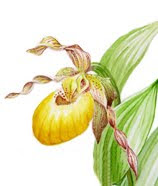
Happy New Year! In spite of gloomy economic news, I try to keep sane by continuing to seek beauty in the world and attempt to paint it. The orchid pictured below, the stemless ladys' slipper, is listed as Endangered in Illinois. Today I learned that no one has seen it in almost ten years - contacting people about the two state records informed me that it's very possible the plant is extirpated. At the very most, there is probably only one colony remaining, and its numbers have plummeted over the years so the news isn't good...
I feel like the authors of the book "Last Chance to See," who travelled all over the world documenting the last years of endangered animals such as the Yangtze River dolphin. Where will this sixth global extinction, in which we are currently living and participating, finally leave us? I shudder to think, but I also believe that human ingenuity, community and caring contains all the answers to solve our weighty global problems.
Subscribe to:
Posts (Atom)